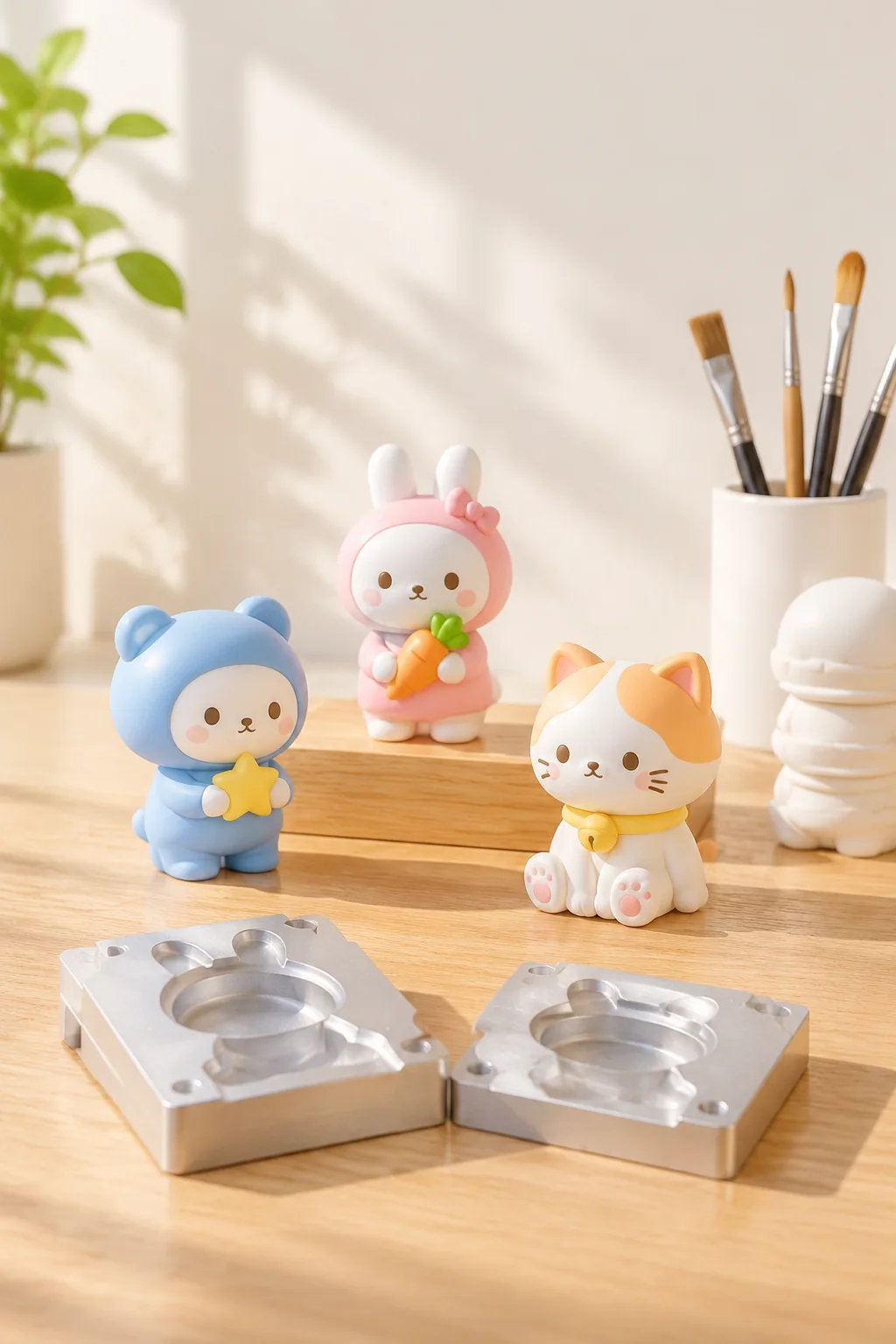
Rotocast wins on anything round, hollow or large relative to its wall. A 120 mm character with a big head and small feet is awkward to inject — the plastic cools before it reaches the extremities — but perfectly happy in a rotating mould. Wall thickness lands between roughly 2.5 and 4 mm, depending on the rotation cycle, and the part comes out hollow, which keeps weight and material cost down.
Injection wins on sharpness and repetition. Undercuts, fine hairlines, separately coloured parts and snap-fit joints all belong to steel. You pay for that in tooling: a steel mould is several times the cost of an aluminium rotocast mould, so the run length has to justify it. Below a few thousand units, injection rarely pays back.
There is a middle route we use often: rotocast the body, inject the small hard parts. A vinyl body with an injected accessory, an injected face plate or a rigid base gets the silhouette of one process and the precision of the other. It also splits the tooling budget into two smaller decisions instead of one large one.
Whichever route, the practical rule is the same: settle the part split before the sculpt is final. Moving a seam after tooling exists is the single most expensive change in the whole programme.